
When Christians speak about stewardship, we often think first about money. Churches have frequently used the language of stewardship when talking about giving, generosity and the way we use our financial resources.
But stewardship is much bigger than that.
It begins with a simple recognition: the world does not belong to us.
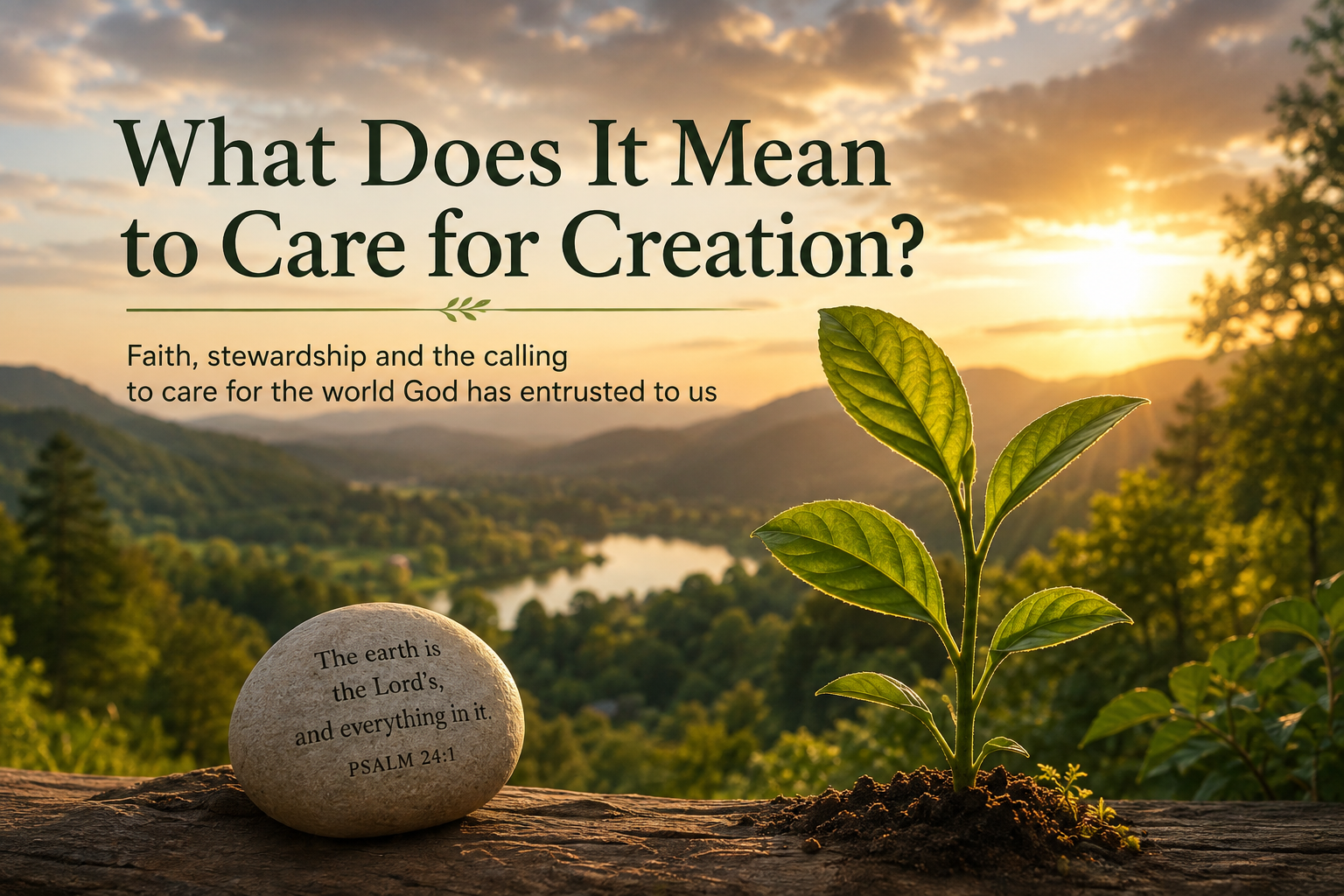
The opening words of Psalm 24 put it plainly: “The earth is the Lord’s, and everything in it.”
If we really believe that, then it must surely affect the way we think about the world around us.
The earth is not simply a collection of resources placed at our disposal. It is part of God’s creation — something we have received, something upon which we depend, and something for which we carry responsibility.
Part of creation
There can sometimes be a tendency in Christian thinking to place humanity at the centre of everything.
The creation story in Genesis certainly gives human beings a particular responsibility within creation. But it also reminds us that we belong to creation.
We are creatures too.
We breathe its air, drink its water and depend upon its soil. The food that sustains us comes from the earth and from the extraordinary web of life of which we are a part.
Perhaps one of the problems of our age is that we have become very good at forgetting this.
Much of modern life allows us to live at a distance from the processes that sustain us. Food appears on supermarket shelves. Water comes from a tap. Energy arrives at the flick of a switch. The things we buy may have travelled thousands of miles before reaching us.
It becomes remarkably easy not to ask where these things came from, how they were produced, or what consequences our choices might have elsewhere.
Yet Christian stewardship invites us to ask those questions.
Dominion or responsibility?
One of the biblical words that has sometimes caused difficulty in our relationship with creation is dominion.
Genesis speaks of humanity having dominion over other living creatures. At times that has been understood as permission to use the natural world largely as we please.
But is that really what dominion looks like when understood through the life of Jesus?
Jesus speaks repeatedly about power, and his understanding of it is striking. Leadership is expressed through service. Greatness is found in becoming the servant of others. Power is not given simply for our own benefit but carries responsibility towards those over whom we have influence.
Perhaps that gives us a different way of thinking about our relationship with creation.
If humanity has been given a particular place within creation, perhaps it is not a licence for exploitation but a calling to care.
Dominion begins to look much more like responsibility.
The choices we make
That can sound rather grand until we bring it into everyday life.
Most of us cannot determine international environmental policy. We cannot personally prevent forests being destroyed or species disappearing. We cannot solve climate change on our own.
But we do make choices every day.
We decide what we buy.
We decide what we throw away.
We decide how we travel.
We decide how much energy we use.
And we decide what we eat.
Each decision may seem very small. Yet together they form patterns of living, and those patterns have consequences beyond ourselves.
This is where stewardship moves from being an idea to becoming part of discipleship.
The question is no longer simply, Do I believe that creation matters?
It becomes, How might that belief become visible in the way I live?
Learning to tread more lightly
None of us will answer that question perfectly.
There is probably no completely environmentally harmless way of living in the modern world. Almost everything we do has some impact somewhere.
Perhaps the aim, then, is not purity but attentiveness.
We can begin to notice.
We can ask where things come from.
We can waste less.
We can consume more thoughtfully.
We can consider the effects our food choices have upon animals, people and the environment.
We can learn to distinguish between what we need and what we simply want.
And sometimes we may discover that relatively small changes in our own lives can become expressions of something much larger.
They can become ways of saying that creation matters.
An expression of love
Perhaps stewardship ultimately belongs alongside Jesus’ command to love.
Love of God cannot easily be separated from love of neighbour. And in an interconnected world, our neighbour may be someone whose life is affected by choices made thousands of miles away.
Our neighbour may also be someone who has not yet been born, who will inherit the world we leave behind.
And perhaps Christian love invites us to extend our concern beyond humanity itself — towards the countless other creatures with whom we share this extraordinary planet.
Caring for creation is therefore not an optional extra for those Christians who happen to be interested in environmental issues.
It is one of the ways in which faith becomes embodied in everyday life.
It will involve questions for which there are no simple answers. It may sometimes challenge habits we have rarely thought about. And it may lead different people to make different choices.
But perhaps that is where stewardship begins.
Not with guilt.
Not with the belief that any one of us can save the planet.
But with gratitude for what we have received, attention to the consequences of the way we live, and a willingness to ask how our lives might reflect greater care for God’s creation.
Perhaps one question is worth carrying with us:
If the earth really is the Lord’s, what might that change about the way I live within it?
Leave a Reply