
David

  • What Does It Mean to Love Your Neighbour?

    What Does It Mean to Love Your Neighbour?

    “Love your neighbour.”

    It is probably one of the best-known sayings of Jesus.

    It sounds simple enough.

    And perhaps that is part of the problem.

    Words that are very familiar can become so familiar that we stop hearing what they ask of us.

    We know that Christians are supposed to love their neighbours. We may even regard ourselves as caring and compassionate people. But what does loving our neighbour actually look like in the ordinary circumstances of daily life?

    And who, exactly, is my neighbour?

    The question behind the question

    Someone once asked Jesus precisely that.

    Luke tells us that an expert in the law wanted to know what he must do to inherit eternal life. Jesus drew him back to the commandments: love God, and love your neighbour as yourself.

    But the man had another question.

    “Who is my neighbour?”

    Perhaps he wanted some clarity.

    Where does my responsibility begin — and where does it end?

    Jesus answered with a story.

    A man is attacked on the road from Jerusalem to Jericho and left badly injured. A priest sees him and passes by. Then a Levite does the same.

    Finally, a Samaritan stops.

    For Jesus’ listeners, that detail mattered. The Samaritan was not the obvious hero. He belonged to a group viewed with suspicion and hostility.

    Yet he is the one who sees the wounded man, is moved with compassion, tends his injuries and makes arrangements for his care.

    At the end of the story, Jesus subtly changes the original question.

    He does not ask, “Which people count as my neighbours?”

    He asks:

    “Which of these three became a neighbour?”

    That feels very different.

    Becoming a neighbour

    Perhaps loving our neighbour is less about deciding who qualifies for our concern and more about the kind of person we choose to become.

    The Samaritan noticed.

    He stopped.

    He allowed someone else’s need to interrupt his journey.

    That may be where loving our neighbour begins.

    Not necessarily with dramatic acts of generosity, but with paying attention.

    The colleague who seems unusually quiet.

    The neighbour we have not seen for several days.

    The person serving us in a shop who is having a difficult morning.

    Someone whose opinion irritates us.

    Someone whose life experience is completely different from our own.

    The person we would normally pass without noticing.

    The invitation to love our neighbour reaches into encounters like these.

    Love is more than feeling warmly

    We often use the word love to describe an emotion.

    But the love Jesus speaks about is much more demanding than simply feeling affection.

    We may not feel particularly warm towards everyone we encounter.

    Some people are difficult.

    Some frustrate us.

    Some hold opinions with which we strongly disagree.

    Some may have hurt us.

    Christian love cannot simply mean pretending those realities do not exist.

    Perhaps it means recognising that the other person still possesses dignity.

    It means refusing to reduce them to the thing we dislike about them.

    It means asking whether our words and actions contribute to their flourishing or diminish it.

    Sometimes love may involve kindness.

    Sometimes listening.

    Sometimes generosity.

    Sometimes forgiveness.

    And sometimes love may require boundaries, particularly where relationships are harmful or abusive. Loving someone does not mean allowing ourselves or others to be mistreated.

    Love is not the absence of wisdom.

    But neither is it simply a feeling.

    It becomes visible in the way we treat people.

    The neighbours we do not choose

    There is another uncomfortable part of Jesus’ story.

    The wounded man did not get to choose who helped him.

    And the Samaritan did not get to choose who was lying beside the road.

    Much of Christian community is like that.

    We often imagine community as finding people with whom we naturally belong — people who think like us, share our interests and make us feel comfortable.

    But neighbours are not always people we would have chosen.

    They may live differently.

    Vote differently.

    Understand faith differently.

    Come from another culture.

    Hold beliefs we find difficult.

    Sometimes the challenge of loving our neighbour begins precisely at the point where similarity ends.

    That does not require us to agree with everyone.

    But it does ask whether disagreement prevents us from seeing another person as a person.

    Love begins with seeing

    One theme has been returning again and again as I have written these reflections.

    We cannot respond to what we refuse to notice.

    Jesus repeatedly noticed people others overlooked.

    He noticed Zacchaeus in the tree.

    He noticed the woman who touched his cloak in the crowd.

    He noticed blind Bartimaeus when others tried to silence him.

    He noticed children when the disciples regarded them as an interruption.

    Again and again, compassion begins with attention.

    Perhaps loving our neighbour begins in the same place.

    Before we can help, speak, give or act, we have to see.

    An ordinary discipleship

    Most of us will not encounter somebody lying injured beside a road today.

    But we will encounter people.

    At home.

    At work.

    In shops.

    Online.

    In our neighbourhoods.

    Perhaps even in church.

    And every encounter contains a small question:

    What does love require of me here?

    The answer will not always be obvious.

    Sometimes it may be nothing more than patience.

    Sometimes it may mean speaking rather than remaining silent.

    Sometimes it will mean giving time.

    Sometimes listening.

    Sometimes offering practical help.

    Sometimes recognising that another person simply needs to be treated with dignity.

    None of these things may appear particularly religious.

    But perhaps this is where discipleship becomes real.

    The invitation to follow Jesus reaches into the whole of life.

    And that means the command to love our neighbour reaches there too.

    Perhaps the question for today is not simply:

    Who is my neighbour?

    Perhaps Jesus still turns the question around and asks:

    To whom might I become a neighbour today?

  • What Do We Do When Christians Disagree?

    What Do We Do When Christians Disagree?

    Christians have always disagreed.

    We sometimes talk as though disagreement is a modern problem, as if earlier generations of Christians all believed the same things and lived in perfect harmony.

    The New Testament tells a rather different story.

    The early Church had disagreements about food, circumcision, religious law, leadership, mission, and the place of Gentile believers. Paul and Barnabas disagreed so sharply about John Mark that they eventually went separate ways. Paul challenged Peter publicly. Different Christian communities wrestled with different questions and sometimes reached different conclusions.

    Disagreement is not something that entered Christianity from outside.

    It has been part of the life of the Church from the beginning.

    The more difficult question is not whether Christians will disagree.

    It is how we behave when we do.

    When disagreement becomes a test of belonging

    Some disagreements are relatively minor.

    Others touch questions that feel central to our understanding of faith, Scripture, morality, identity or the nature of the Church.

    That is when things become harder.

    We can begin to feel that if someone disagrees with us, they are not simply mistaken about one issue. We may start to question whether they are faithful Christians at all.

    The disagreement becomes a boundary.

    Are you one of us?

    Do you believe the right things?

    Can you still belong if you reach a different conclusion?

    Of course, Christian faith does have convictions. A faith that can mean absolutely anything eventually means very little.

    But there is still a difference between having convictions and treating every disagreement as a test of faithfulness.

    One of the disciplines of a mature faith may be learning to distinguish between what is central and what is not.

    And perhaps also recognising that Christians of equal sincerity can sometimes read the same Bible, pray to the same God, seek to follow the same Jesus, and still reach different conclusions.

    Why disagreement feels threatening

    I suspect one reason disagreement becomes so difficult is that faith is deeply personal.

    Our beliefs are not simply ideas we happen to hold.

    They may be tied to our family, our community, our sense of identity and the experiences that have shaped us.

    So when somebody questions something we believe, it can feel as though they are questioning us.

    That may be why conversations about faith can become defensive so quickly.

    We stop listening because we are already preparing our reply.

    We assume that changing our mind would mean betraying something important.

    We begin to listen for weaknesses in the other person’s argument rather than trying to understand what has led them to their position.

    And sometimes the conversation simply ends.

    I once knew a woman whose faith had developed thoughtfully through many years of life, prayer and Bible study. She told me that she would never discuss her beliefs with even her closest friend at church because she was afraid that discovering they understood faith differently might damage their friendship.

    I found that deeply sad.

    These were exactly the people with whom she should have been able to talk openly.

    A Christian community ought to be one of the places where difficult questions can be explored without relationships becoming casualties.

    Conviction and humility

    Perhaps one of the most helpful things we can bring to disagreement is humility.

    Humility does not mean pretending we have no convictions.

    It means recognising that our understanding is never complete.

    Earlier in this series, I wrote about the fact that all of us interpret Scripture. We read ancient words from particular cultures, experiences and assumptions of our own.

    That means I can take my beliefs seriously while still recognising the possibility that I may have misunderstood something.

    The words I might be wrong are not a betrayal of faith.

    Sometimes they are an expression of it.

    Humility allows us to listen.

    It allows us to ask, “What has led you to understand this differently?”

    It allows another person’s experience to challenge assumptions we may never have noticed.

    And it makes room for the possibility that neither of us has understood the whole truth.

    Reading disagreement through Jesus

    For Christians, Jesus must surely shape not only what we believe but the way we disagree.

    Jesus could challenge people very directly.

    He was not afraid of difficult conversations.

    But the pattern of his life continually drew people towards compassion, truth, restoration and love of neighbour.

    That gives us some difficult questions to ask about our own disagreements.

    Does the way I speak about people with whom I disagree reflect the character of Jesus?

    Am I interested in understanding them, or simply defeating them?

    Can I disagree without caricaturing their position?

    Can I acknowledge something good or true in what they are saying?

    Can I remain in relationship when we do not reach agreement?

    These questions matter because it is possible to defend a Christian position in a profoundly unchristian way.

    Winning an argument is not the same as bearing good fruit.

    Staying at the table

    There will, of course, be occasions when disagreement has real consequences.

    Sometimes decisions have to be made.

    Sometimes boundaries matter.

    Sometimes remaining in a particular relationship or institution becomes extremely difficult.

    Christian unity does not mean pretending differences are unimportant.

    But I wonder whether we too quickly assume that disagreement must lead to separation.

    There is something deeply Christian about staying at the table.

    Listening again.

    Trying to understand.

    Sharing bread with people whose conclusions differ from our own.

    Recognising that the person across from us is more than the opinion with which we disagree.

    The Church does not need to be a place where everybody thinks alike.

    Perhaps it should be a place where people learn how to disagree without ceasing to love one another.

    A wider faith

    A wider faith is not a faith in which anything goes.

    It is a faith spacious enough for conversation.

    Spacious enough for questions.

    Spacious enough to recognise that our understanding can grow and change.

    And spacious enough to remain in relationship with people who see some things differently.

    That may be particularly important in a world where disagreement so easily becomes hostility and where we are increasingly encouraged to divide people into opposing camps.

    Perhaps Christian communities could offer something different.

    Not agreement at any cost.

    Not the abandonment of conviction.

    But a way of speaking, listening and living together in which love is not dependent upon uniformity.

    Perhaps one of the most important questions we can ask when Christians disagree is not simply:

    Who is right?

    But:

    How can we seek truth together without losing sight of one another?

  • When Healing Does Not Mean Cure

    When Healing Does Not Mean Cure

    One of the difficulties with talking about Christian healing is that the word healing can so easily become confused with the word cure.

    When someone is ill, understandably we hope for recovery. We pray for treatment to work, for pain to lessen, for the body to be restored. Sometimes that happens, and when it does there is much to be thankful for.

    But sometimes it does not.

    Illness continues. Treatment reaches its limits. A condition becomes something a person must learn to live with. And eventually, for every one of us, there comes a point when physical life itself cannot be prolonged.

    So what do we mean by healing then?

    If Christian healing means only physical cure, we are left with some very difficult conclusions. We may begin to wonder whether prayers have failed, whether faith has been insufficient, or whether God has somehow withheld something that might have been given.

    I do not think that is a helpful or faithful way to understand healing.

    Healing is bigger than cure

    In the Gospels, Jesus certainly heals bodies. People who are blind see. Those who cannot walk are restored. People suffering from illness are made well.

    But something more is often happening.

    People who have been excluded are welcomed back into community. Those burdened by guilt hear words of forgiveness. Those regarded as unclean are touched. Those pushed to the margins are noticed and restored to dignity.

    Healing involves bodies, but it also involves relationships, identity, hope and belonging.

    That matters because these dimensions of healing may still be possible when physical cure is not.

    A person living with a long-term illness may discover peace where there had been fear.

    A broken relationship may be reconciled.

    Someone approaching the end of life may find that unfinished conversations can finally take place.

    A person who has felt defined by illness may begin to recognise again that they are more than a diagnosis.

    None of these things removes the reality of suffering.

    But they may bring something of wholeness within it.

    The danger of easy answers

    Christians sometimes speak about healing in ways that place an enormous burden on people who are already suffering.

    “Have enough faith.”

    “Believe that you will be healed.”

    “Don’t doubt.”

    Such words may be offered with good intentions, but they can leave a person feeling responsible when cure does not come.

    The Gospels do not present suffering as something that can always be explained so neatly.

    Jesus himself weeps.

    He shares the grief of others.

    He does not stand at a safe distance from human pain offering simple explanations. He enters it.

    Perhaps Christian healing ministry should begin there too — not with certainty about what God must do, but with compassionate presence.

    Sometimes the most healing thing we can offer is not an answer but the willingness to remain beside someone when there is no easy answer.

    Praying honestly

    This does not mean that we stop praying for physical healing.

    I think it is entirely right to pray boldly for recovery, for successful treatment, for relief from pain and for strength.

    But perhaps our prayers can also become wider.

    We can pray for courage.

    For peace.

    For good medical care.

    For wisdom for those making difficult decisions.

    For reconciliation.

    For freedom from fear.

    For people to know that they are loved and not abandoned.

    And sometimes we may simply pray that, whatever happens, the person will know something of God’s presence within it.

    That is not giving up on healing.

    It is recognising that healing may take forms we did not initially expect.

    Wholeness in the midst of vulnerability

    There is a temptation to think of wholeness as a state in which everything has been repaired.

    But human life is rarely like that.

    We carry scars, losses, disappointments and limitations. Some remain with us for the rest of our lives.

    Perhaps wholeness does not mean becoming untouched by suffering.

    Perhaps it means discovering that suffering does not have the final word about who we are.

    Christian faith speaks of a God who meets us not only in strength but in vulnerability; not only in life as we would wish it to be, but in life as it actually is.

    That may be one of the deepest gifts of the healing ministry.

    It allows us to pray for change while also recognising grace in the present.

    To hope without pretending.

    To accompany rather than explain.

    And to trust that a person’s worth is never measured by whether their body has been cured.

    Physical cure is one expression of healing.

    But healing can also be found in peace, reconciliation, dignity, hope, love and the restoration of relationships.

    Perhaps the question is not only:

    Will this person be cured?

    Perhaps we might also ask:

    Where might God’s healing and wholeness already be taking shape in this person’s life?

  • Caring for Creation: Where Does Responsibility Begin?

    Caring for Creation: Where Does Responsibility Begin?

    It is easy to feel overwhelmed when we think about the state of the world.

    We hear about rising temperatures, disappearing habitats, pollution and the loss of species. The scale of the problems can leave us wondering whether anything we do as individuals can really make a difference.

    Perhaps that is one reason why conversations about caring for creation sometimes become difficult. We can find ourselves caught between anxiety about the future and a sense of helplessness in the present.

    But I wonder whether Christian faith offers us another place to begin.

    A world entrusted to our care

    The opening chapters of Genesis describe a world that God calls good. Before human beings enter the story, the earth is already full of life and value.

    That matters.

    Creation is not simply a collection of resources waiting for us to use. It is something we receive, something of which we are part, and something for which we have responsibility.

    Genesis speaks of humanity being given dominion over the earth. That word has sometimes been understood as permission to do whatever we please. Yet, when we read Scripture through Jesus, a different understanding of power emerges.

    Jesus speaks of greatness in terms of service. He shows us authority exercised through love, care and self-giving.

    What might dominion look like if we understood it in that way?

    Perhaps it would mean approaching the natural world not as owners entitled to take whatever we want, but as people entrusted with the care of something precious.

    The choices of ordinary life

    Of course, caring for creation involves questions far larger than any one household can resolve. Governments, industries and international institutions have responsibilities that cannot simply be passed on to individuals.

    Yet the fact that we cannot do everything does not mean that we can do nothing.

    Our daily choices connect us to the wider world, often in ways we barely notice.

    The food we eat, the things we buy, the energy we use and what we choose to throw away all have consequences beyond our immediate surroundings.

    I have found that thinking about these connections changes the questions I ask.

    Instead of asking only, What do I want?, I begin to ask, What has made this possible? Who or what has been affected along the way? Is there another way of doing this?

    These are not always easy questions, and the answers are rarely straightforward. Cost, health, circumstances and the options available to us all matter. What is possible for one person may be difficult for another.

    The purpose is not to achieve a perfect lifestyle. It is to become more attentive to the consequences of the lives we lead.

    Compassion beyond ourselves

    One of the things that has increasingly shaped my own thinking is the relationship between caring for creation and compassion.

    We often speak about loving our neighbours as though the question concerns only the people immediately around us. But our choices can affect people we will never meet, including those whose lives are already being disrupted by environmental damage.

    They also affect the other creatures with whom we share this planet.

    For me, this has led to reflection on what I eat and the place of a plant-based diet in my understanding of Christian stewardship. It is one way in which I am seeking to bring my everyday choices into closer conversation with my faith.

    I do not imagine that everyone will reach the same conclusions or make the same changes. But I believe the questions deserve our attention.

    If compassion is central to following Jesus, how widely are we prepared to extend it?

    Beginning where we are

    Perhaps the most helpful place to begin is not with an ambitious promise to change everything, but with a willingness to notice.

    We might begin by learning more about where our food comes from, reducing something we regularly waste, or reconsidering a purchase we would once have made without a second thought.

    One small change may lead to another. Some attempts will work; others may prove impractical. We can learn without turning every decision into a test of our faithfulness.

    Christian discipleship has never been confined to the explicitly religious parts of life.

    The invitation to follow Jesus reaches into the whole of life.

    That includes our relationship with the earth, with those who share its resources, and with the generations who will inherit what we leave behind.

    We may not be able to solve the world’s environmental problems through our individual choices. But we can begin to live as though creation really is a gift entrusted to our care.

    And perhaps that is where responsibility begins.

  • Finding God in Ordinary Things

    Finding God in Ordinary Things

    Sometimes we imagine that encountering God must involve something extraordinary.

    Perhaps we expect a moment of deep prayer, a powerful experience in worship, or an unmistakable sense of God’s presence. And sometimes those experiences do come. But I wonder whether, in looking for the extraordinary, we can overlook the ordinary places where God may already be at work.

    Most of our lives are made up of fairly unremarkable moments. We prepare meals, answer messages, travel to work, do the shopping, meet neighbours and deal with the countless small demands of everyday life. Much of it can feel routine, and sometimes rather tiring.

    Yet these are the places where we actually live.

    In Monday’s reflection, I suggested that most of the Christian life is lived on a Monday. If following Jesus is about more than what we believe or what happens when we gather for worship, perhaps we need to learn to look at these ordinary moments differently.

    Jesus often began with the familiar. He spoke about seeds and soil, bread and water, birds and flowers. He noticed people others passed by. He shared meals, welcomed interruptions and took time for conversations that might have seemed unimportant to everyone else.

    He helped people discover something of God in the world immediately around them.

    Perhaps that is an invitation for us, too.

    A conversation with someone who needs to be heard may become an opportunity to offer compassion. An unexpected interruption might remind us that the person in front of us matters more than the task we are trying to finish. Even a familiar journey can become an occasion to notice the beauty of creation or the needs of our community.

    None of these things requires us to do something spectacular. They ask us to be present, attentive and willing to respond.

    Of course, not every ordinary moment feels meaningful. Some days are difficult, repetitive or simply exhausting. We need not pretend otherwise, or feel that we have somehow failed when we cannot recognise anything particularly spiritual in them.

    But perhaps finding God in ordinary things is less about turning every moment into a religious experience and more about learning to live with an awareness that God is not confined to the places we call sacred.

    The invitation to follow Jesus reaches into the whole of life.

    And sometimes, when we begin to pay attention, we may discover that an ordinary day offers more opportunities for love, grace and compassion than we had imagined.

    A question for the rest of the week:

    What ordinary moment or encounter might I approach differently today if I were more attentive to the possibility of God’s presence?

  • Faith Beyond Sunday: What Does Christian Discipleship Look Like in Everyday Life?

    Faith Beyond Sunday: What Does Christian Discipleship Look Like in Everyday Life?

    Most of the Christian life is lived on a Monday.

    Not in church. Not during a hymn or a prayer. Not while listening to a sermon or receiving Communion.

    It is lived while making breakfast, travelling to work, answering an email, talking to a neighbour, deciding what to buy, caring for someone, becoming irritated with somebody, watching the news, walking through a park or wondering how we are going to get through everything that needs doing that day.

    Sunday matters. Gathering for worship matters. Prayer, Scripture and Christian community can nourish us, challenge us and help us see our lives differently.

    But if following Jesus means anything, surely its influence cannot end when we leave the church building.

    Perhaps one of the most important questions of discipleship is therefore also one of the simplest:

    What difference does following Jesus make to the way I live an ordinary day?

    Learning to notice

    One of the things that strikes me when I read the Gospels is how often Jesus notices people.

    He notices people others pass by.

    He notices Zacchaeus in the tree. He notices Bartimaeus calling from the roadside. He notices the woman who touches his cloak in the crowd. He notices children when others apparently consider them an interruption.

    Again and again, Jesus seems to see people whom others have stopped seeing.

    I was reminded of this when I first came to Sutton Coldfield. The town is generally regarded as an affluent area, and people knew that I had previously ministered in a much more deprived community. One day, while talking about homelessness, a woman said to me, “But there is no poverty in Sutton Coldfield.”

    I began to describe some of the people I had encountered on the main shopping street: people sitting in doorways, others spending their days on benches, drinking from cans or asking passers-by for money. One man had told me that he had been sleeping rough in the town for thirty years.

    She was astonished.

    The problem wasn’t that she lacked compassion. She simply hadn’t noticed them.

    And I suspect she wasn’t unusual.

    Perhaps people can become part of the scenery we pass every day. Like an old poster on a noticeboard, they have been there for so long that eventually we stop seeing them.

    But something began to change.

    People started noticing. Conversations followed. Attitudes began to shift. And eventually members of the congregation called for us to establish a food bank, which has now been serving the community for thirteen years.

    It began, in a sense, with seeing what had always been there.

    Perhaps that is one of the places where everyday discipleship begins.

    With noticing.

    Who do I pass without really seeing?

    Who serves me in a shop or café without my giving them much thought?

    Who lives nearby but rarely has anyone stop to talk?

    Who seems quieter than usual?

    Who might need someone simply to listen?

    We cannot respond to every need we encounter, and trying to do so would quickly become overwhelming. But perhaps following Jesus gradually teaches us to move through the world with our eyes a little more open.

    Sometimes discipleship may begin simply by noticing the person in front of us.

    The choices nobody sees

    Some of the decisions that shape our lives seem very ordinary.

    What we buy.

    What we eat.

    How we spend our money.

    How much we consume.

    How we treat the things we own.

    What we throw away.

    Where our money is invested.

    None of these necessarily feels particularly spiritual.

    And yet our everyday choices connect us with people and places we may never see. The food on our plate, the clothes we wear, the energy we use and the things we buy all have stories behind them.

    There are people involved.

    There are animals involved.

    There is creation involved.

    Perhaps discipleship includes becoming more curious about those connections.

    Not because there is always one perfectly Christian choice. Life is usually more complicated than that.

    But following Jesus might lead us to ask different questions.

    Do my choices reflect compassion?

    Who or what bears the cost of the way I live?

    Do I really need this?

    Could I use what I have differently?

    These may not be questions we traditionally associate with discipleship.

    Perhaps they should be.

    Relationships as places of discipleship

    It is relatively easy to speak about love in the abstract.

    It becomes rather more demanding when love has a name and a face.

    Jesus’ command to love our neighbour sounds wonderfully inspiring until our neighbour irritates us.

    Forgiveness sounds beautiful until there is actually something to forgive.

    Patience sounds admirable until someone tries it.

    This is where faith becomes very ordinary indeed.

    It appears in the way we speak to someone when we are tired.

    In whether we listen or merely wait for our turn to speak.

    In how quickly we judge someone whose life we don’t understand.

    In whether we need to win every disagreement.

    In whether we are willing to apologise.

    In whether we can forgive.

    And perhaps in whether we can disagree with someone while continuing to treat them with dignity and love.

    None of these things is dramatic.

    Most will never be noticed by anyone else.

    But perhaps this is precisely where discipleship is formed.

    Not primarily in the great declarations of faith we make, but in the thousands of small encounters through which we learn what love actually requires.

    What do we do with what we have?

    Jesus spoke surprisingly often about money and possessions.

    Perhaps that is because what we do with what we have reveals something about what we value.

    For most of us, decisions about money are also very practical. There are bills to pay, responsibilities to meet and futures to think about. Christian discipleship does not remove those realities.

    But it may change the questions we ask about them.

    How much is enough?

    What does generosity look like for me?

    What am I accumulating, and why?

    How much of my security depends upon possessing more?

    Could something I have become a blessing to somebody else?

    These questions are not invitations to guilt.

    They are invitations to freedom.

    Jesus repeatedly warned about the danger of allowing possessions to possess us.

    Perhaps generosity is one way of loosening their grip.

    Finding God in ordinary things

    There is another danger in separating Sunday faith from weekday life.

    We can begin to imagine that God is particularly present in certain places and moments.

    Church.

    Prayer.

    Holy Communion.

    A retreat.

    A beautiful act of worship.

    And God may indeed meet us profoundly in those places.

    But what if God is also waiting to be noticed elsewhere?

    In a conversation.

    In a meal shared with someone.

    In the first signs of spring.

    In laughter.

    In silence.

    In an unexpected kindness.

    In the person who needs our attention.

    In the opportunity to forgive.

    In the beauty of the world around us.

    Perhaps part of discipleship is learning to recognise the sacred woven through the ordinary.

    Not because everything that happens is good or because every experience has been sent by God.

    But because there may be no part of our lives in which God’s presence and invitation cannot be encountered.

    When the Kingdom becomes visible

    Jesus spoke repeatedly about the Kingdom of God.

    He did not describe it simply as somewhere we go after we die. He spoke about something drawing near. Something beginning. Something that could already be glimpsed.

    A different way of living.

    A world in which the hungry are fed, the excluded are welcomed, the broken are restored, enemies can become neighbours and those whom society overlooks are seen.

    Christians have prayed for centuries:

    “Your kingdom come, your will be done, on earth as it is in heaven.”

    Perhaps everyday discipleship is one of the ways that prayer begins to take flesh.

    Whenever compassion replaces indifference.

    Whenever forgiveness interrupts resentment.

    Whenever generosity challenges greed.

    Whenever someone who has been excluded is welcomed.

    Whenever creation is treated with care rather than simply as something to consume.

    Whenever another human being is truly seen.

    None of these actions creates the Kingdom of God by itself.

    But perhaps they allow us to glimpse what God’s Kingdom looks like.

    Monday morning

    Most of us will never do anything that the world considers extraordinary.

    Our lives are largely made up of ordinary days.

    Meals.

    Conversations.

    Work.

    Shopping.

    Friendships.

    Responsibilities.

    Mistakes.

    Decisions.

    Moments of kindness and moments when we wish we had behaved differently.

    And perhaps that is not a problem for Christian discipleship.

    Perhaps ordinary life is exactly where discipleship belongs.

    Following Jesus does not necessarily mean adding more religious activity to an already crowded week.

    It may mean learning to live the life we already have differently.

    To notice more.

    To listen more carefully.

    To consume more thoughtfully.

    To forgive more readily.

    To hold what we possess a little more lightly.

    To recognise God in places we might previously have overlooked.

    And then, when Monday morning comes around again, perhaps the question is not simply:

    What do I have to do today?

    But also:

    How might following Jesus become visible in the way I do it?

  • The Permission to Ask Questions

    The Permission to Ask Questions

    There are some questions we ask easily.

    And there are others we hesitate to say aloud.

    Questions about God. Questions about the Bible. Questions about things we have been taught to believe. Questions that arise because something has happened in our lives that doesn’t seem to fit comfortably with the faith we thought we understood.

    Sometimes the question itself isn’t the hardest part.

    The hardest part is wondering whether we are allowed to ask it.

    I have encountered people over the years who have worried that questioning something about their Christian faith meant that their faith was failing. Perhaps they had been given the impression that strong faith meant being certain, while questions belonged to those who didn’t believe enough.

    I don’t think that is true.

    In fact, I increasingly wonder whether some questions arise precisely because we do take our faith seriously.

    If something doesn’t make sense, we want to understand.

    If an interpretation of Scripture seems inconsistent with the Jesus we encounter in the Gospels, we want to look again.

    If something we have been taught about God doesn’t seem to fit with our experience of suffering, love or the world around us, we want to know why.

    Those aren’t necessarily signs that faith is disappearing.

    They may be signs that faith is growing.

    Questions have always belonged to faith

    The Bible is full of questions.

    The Psalmists ask where God is.

    Job wants to know why he is suffering.

    The prophets question a society that claims to worship God while tolerating injustice.

    The disciples repeatedly ask Jesus what he means—and frequently misunderstand the answer.

    Even Jesus asks questions.

    Questions seem to belong naturally within the life of faith.

    And yet Christian communities can sometimes become uncomfortable with them.

    Perhaps that is because questions can take us somewhere unexpected.

    Once we begin asking Why do we believe this? or Is this really what this passage means?, there is no guarantee that we will arrive back at precisely the place from which we started.

    That can feel unsettling.

    But perhaps faith was never meant to leave us exactly where we started.

    A safe answer isn’t always a good answer

    There can be a temptation, particularly when someone is struggling, to offer an answer quickly.

    Sometimes that comes from kindness. We want to help.

    But there are experiences for which a neat theological answer can feel painfully inadequate.

    Why did this person die?

    Why wasn’t my prayer answered?

    Why does God allow this suffering?

    Why does a loving God seem absent?

    Why does the Bible say this?

    Why has the Church taught that?

    There are times when saying “I don’t know” may be more faithful than offering an answer simply because we feel Christians ought to have one.

    It leaves the question open.

    And sometimes an open question is where an important journey begins.

    Questions can change us

    My own Christian journey began with questions, and the questions haven’t stopped.

    Some have found answers.

    Some have changed.

    Some no longer seem as important as they once did.

    And others have grown larger.

    But over time I have become less frightened of them.

    Perhaps that is because I’ve come to see faith less as possessing a complete set of answers and more as learning to trust while continuing to explore.

    There is a humility in that.

    It allows us to say:

    This is what I believe.

    This is why I believe it.

    But I am still listening.

    That final sentence matters.

    Because if we already possess every answer, there is very little left for us to discover.

    A community where questions are welcome

    I think Christian communities should be places where people can ask difficult questions without fearing that they will be judged for asking them.

    Some years ago, a woman who was a member of one of my congregations said something to me that has stayed with me. She had a strong and thoughtful Christian faith, shaped over many years both by studying the Bible and by the experiences of her life.

    Yet she told me that she wouldn’t discuss some of her understanding of faith, even with her best friend at church. She was afraid that if they discovered they understood or believed things differently, it might damage their friendship.

    I remember feeling very sad when she said that.

    Because surely these were exactly the people with whom she should have been able to have those conversations.

    What kind of Christian community are we creating if people who have worshipped together, prayed together and become close friends still feel that their friendship might not survive an honest conversation about what they believe?

    Perhaps we need to become better at disagreeing.

    Christian conversation doesn’t require us to arrive at the same conclusion about everything. We can listen to someone else’s understanding without feeling that it threatens our own. We can ask why they see something differently. We can even allow their experience to make us look again at something we thought we had settled.

    And sometimes we may simply say:

    “I see that differently, but I want to understand why you see it that way.”

    There could be something deeply Christian about that kind of conversation.

    We don’t have to agree with every conclusion. But we can listen.

    One of the things I have learned through ministry is that sometimes people don’t initially need us to answer their question.

    They need to know that we have heard it.

    And occasionally what appears to be a theological question is carrying something much deeper: disappointment, grief, anger, exclusion or hurt.

    Listening may therefore be one of the most important responses we can offer.

    Keep asking

    A Wider Faith is intended to be a place where questions are welcome.

    Not because nothing matters.

    Not because every answer is equally good.

    And not because Christian faith is simply whatever we decide we want it to be.

    We ask questions because faith matters enough to explore.

    We return to Scripture.

    We return to Jesus.

    We listen to one another.

    We learn from those who have travelled before us.

    And sometimes we change our minds.

    Perhaps there is nothing particularly frightening about that.

    After all, the disciples who first responded to Jesus’ invitation did not know where following him would lead.

    They simply began to follow.

    Maybe we don’t need to have every question answered before we do the same.

    Sometimes we just need permission to ask the question—and the courage to listen for where it might lead.

  • Can We Take the Bible Seriously Without Taking Everything Literally?

    Can We Take the Bible Seriously Without Taking Everything Literally?

    There was a time when I thought that taking the Bible seriously meant that I had to take everything in it literally.

    Perhaps that isn’t surprising. When we first begin exploring Christian faith, we often look for certainty. We want to know what Christianity teaches, what we are supposed to believe, and where we can find reliable answers. And for Christians, the Bible seems the obvious place to look.

    But the more I read the Bible, the more I began to realise that the question was not quite as simple as I had imagined.

    The Bible itself seemed to resist being read in only one way.

    There were stories and histories, poems and prayers, letters and visions. There were parables told by Jesus and songs written by people experiencing joy, anger, despair and hope. There were ancient laws, prophetic warnings, wisdom sayings and accounts of communities trying to understand what God was doing among them.

    And gradually another question began to emerge.

    Perhaps the issue isn’t simply whether we take the Bible literally.

    Perhaps the more important question is:

    How do we take the Bible seriously?

    What kind of book is the Bible?

    One of the first things we discover when we begin looking closely at the Bible is that it isn’t really a single book.

    It is a library.

    Within its pages are writings produced in different periods, in different circumstances and for different purposes. Some tell stories. Some preserve laws. Some offer wisdom. Some are poetry. Some are letters written to particular Christian communities facing particular problems.

    That matters because we don’t read every kind of writing in the same way.

    When the Psalmist says that the trees of the field clap their hands, we don’t imagine branches literally applauding. The poetry is doing something much richer than giving us botanical information.

    When Jesus tells the story of the Good Samaritan, the significance of the story doesn’t depend upon us proving that a particular traveller once left Jerusalem for Jericho and was attacked by particular robbers.

    The question is not, Did this happen exactly as described?

    The question Jesus leaves with his listener is much more demanding:

    Which of these people became a neighbour?

    And then:

    Go and do likewise.

    Recognising the kind of writing we are reading doesn’t make Scripture less important.

    It helps us hear what Scripture is actually saying.

    Literal isn’t always the same as faithful

    Sometimes Christians worry that once we stop insisting upon a literal interpretation of every biblical passage, anything becomes possible.

    If this isn’t literal, what else can we question?

    It is an understandable concern.

    But there is another danger.

    We can become so concerned with defending whether something happened literally that we fail to ask what the biblical writer is trying to tell us.

    Genesis is an obvious example.

    Christians can spend enormous amounts of energy debating precisely how and when the world was created. But the opening chapters of Genesis are asking some extraordinarily profound questions.

    Why is there something rather than nothing?

    What is the relationship between God and creation?

    What does it mean to say that creation is good?

    What does it mean to be human?

    What responsibilities accompany our place within creation?

    What has gone wrong with the relationship between human beings, God, one another and the earth?

    Those questions haven’t become less important because modern science can tell us things about the development of the universe that the ancient writers could never have known.

    If anything, they have become more important.

    Science can help us investigate how the universe developed.

    Scripture invites us to wrestle with questions of meaning, relationship and responsibility.

    They aren’t necessarily rival conversations.

    Context matters

    There is another reason we need to do more than simply read the words on the page.

    The Bible was not originally written to twenty-first-century Christians in Britain.

    Its writers and first readers inhabited cultures very different from ours. They lived with assumptions about family, society, power, gender, slavery, warfare, illness, government and the natural world that may be unfamiliar to us.

    That doesn’t mean their words have nothing to say to us.

    It means understanding them requires some work.

    When we read one of Paul’s letters, for example, we are effectively reading somebody else’s correspondence. We hear Paul’s side of a conversation with a Christian community in Corinth, Rome, Galatia or elsewhere, often without possessing the letter or message that prompted his response.

    So we ask questions.

    What was happening?

    Who was being addressed?

    What problem was the writer responding to?

    What would these words have meant to their first hearers?

    And only then do we ask:

    What might they mean for us?

    That isn’t avoiding the authority of Scripture.

    It is taking Scripture seriously enough to listen before assuming that we already know what it says.

    But doesn’t interpretation make everything subjective?

    Perhaps this is where things become uncomfortable.

    If interpretation is involved, how do we stop ourselves simply making the Bible say whatever we want it to say?

    It is an important question because interpretation can certainly be misused.

    But there is no completely interpretation-free way of reading the Bible.

    The moment we read an ancient text in a modern language, make decisions about which passages apply directly to us, compare one biblical passage with another, or try to understand what a writer meant, we are interpreting.

    The choice isn’t really between:

    interpreting the Bible

    and

    simply believing the Bible.

    We all interpret.

    The more useful question is whether we do so thoughtfully, prayerfully and honestly.

    That means allowing Scripture to challenge us rather than merely looking for verses that confirm what we already think.

    It means listening to other Christians.

    It means learning something about history and biblical scholarship.

    It means recognising that Christians before us have sometimes been deeply confident about interpretations that later generations came to question.

    And perhaps it also requires humility.

    We may occasionally have to say:

    I might be wrong.

    That isn’t the opposite of faith.

    It may be one of the disciplines faith requires.

    Reading the Bible through Jesus

    For Christians, there is another important part of the conversation.

    At the centre of Christian faith is not a book.

    It is Jesus.

    That doesn’t diminish the Bible. Quite the opposite: the Bible is the principal way through which we encounter the story of Jesus and the faith from which he emerged.

    But it does affect how Christians read Scripture.

    Jesus himself interpreted Scripture. He debated its meaning. He challenged interpretations that placed religious observance above compassion. Again and again he drew people back towards love of God and love of neighbour.

    So when I encounter a biblical interpretation that seems to produce cruelty rather than compassion, exclusion rather than restoration, or self-righteousness rather than love, I think it is reasonable to return to Jesus and ask whether something has gone wrong in the way we are reading.

    Not because Jesus gives us an easy rule for resolving every difficult passage.

    He doesn’t.

    But because Christians believe that in Jesus we see something decisive about the character and purposes of God.

    He therefore becomes more than another subject within the Bible.

    He becomes the one through whom Christians learn to read it.

    A Bible big enough for questions

    Perhaps one of the great gifts of the Bible is that it doesn’t hide the questions.

    Job argues.

    The Psalmists complain.

    Ecclesiastes wonders what any of it means.

    Prophets challenge accepted religious practice.

    The disciples misunderstand Jesus.

    Early Christians disagree about what faithfulness requires.

    Even within Scripture, faith is not presented as a world in which everyone possesses simple answers.

    It is a continuing conversation about God, humanity, suffering, hope, justice, love, failure and redemption.

    That makes the Bible, for me, not less trustworthy but more compelling.

    It contains people wrestling with God rather than merely talking about God.

    And it gives us permission to wrestle too.

    Taking Scripture seriously

    So can we take the Bible seriously without taking everything literally?

    I believe we can.

    Indeed, sometimes taking the Bible seriously may require us not to read a passage literally.

    Taking Scripture seriously means asking what kind of writing we are reading.

    It means paying attention to context.

    It means listening for what the writer was trying to communicate.

    It means being willing to learn from scholarship and from other Christians.

    It means recognising our own assumptions.

    And it means returning again and again to Jesus.

    None of that gives us an easy Bible.

    Perhaps we shouldn’t expect one.

    The Bible has accompanied communities of faith for centuries precisely because each generation finds itself returning to these ancient words with new circumstances and new questions.

    And perhaps the aim isn’t simply to reach the point where we can say:

    I know what the Bible says.

    Perhaps the deeper question is:

    What is God inviting us to see through these words—and what difference might that make to the way we live?

    That seems to me a much more interesting reason to keep reading.

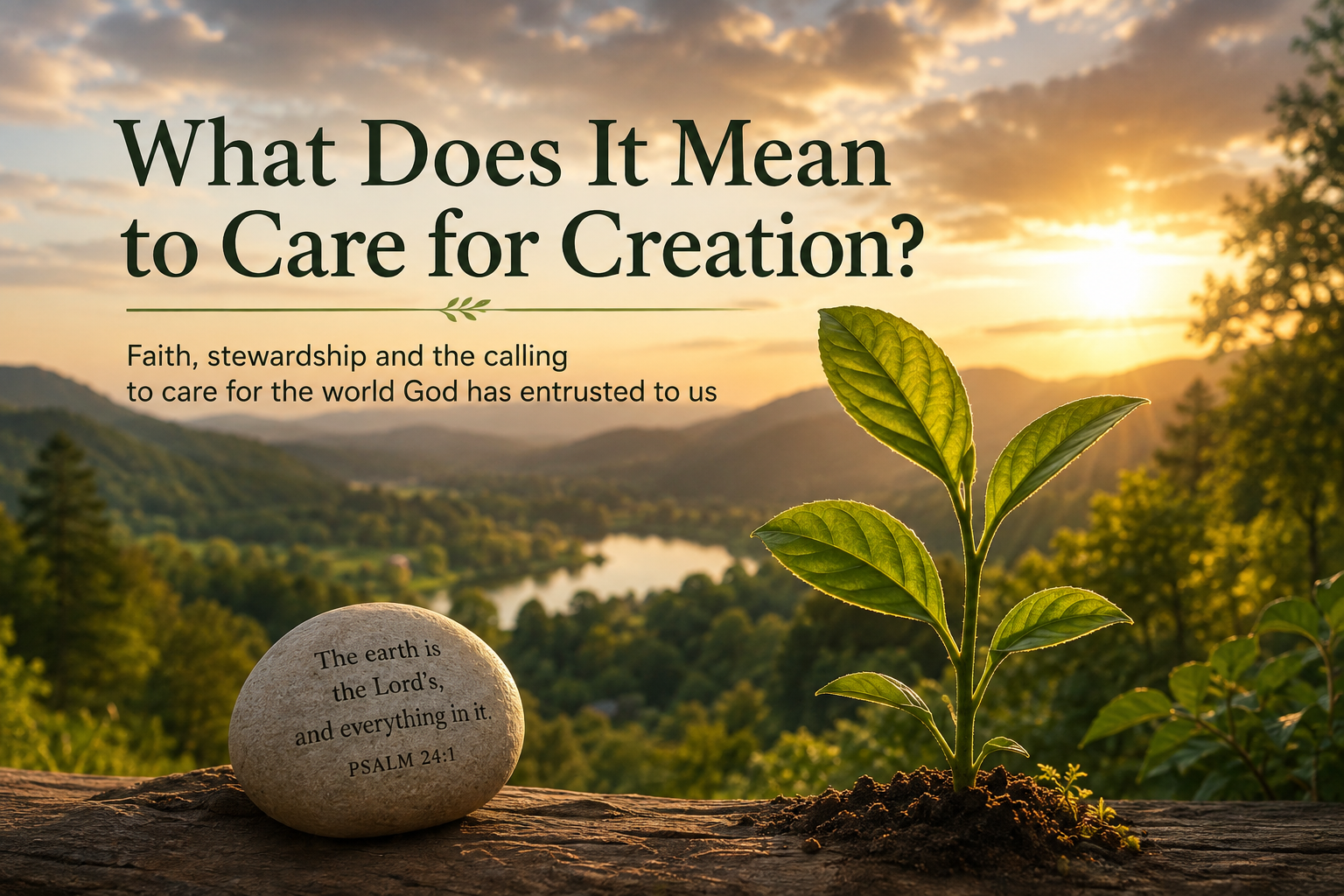
  • What Does It Mean to Care for Creation?

    What Does It Mean to Care for Creation?

    When Christians speak about stewardship, we often think first about money. Churches have frequently used the language of stewardship when talking about giving, generosity and the way we use our financial resources.

    But stewardship is much bigger than that.

    It begins with a simple recognition: the world does not belong to us.

    The opening words of Psalm 24 put it plainly: “The earth is the Lord’s, and everything in it.”

    If we really believe that, then it must surely affect the way we think about the world around us.

    The earth is not simply a collection of resources placed at our disposal. It is part of God’s creation — something we have received, something upon which we depend, and something for which we carry responsibility.

    Part of creation

    There can sometimes be a tendency in Christian thinking to place humanity at the centre of everything.

    The creation story in Genesis certainly gives human beings a particular responsibility within creation. But it also reminds us that we belong to creation.

    We are creatures too.

    We breathe its air, drink its water and depend upon its soil. The food that sustains us comes from the earth and from the extraordinary web of life of which we are a part.

    Perhaps one of the problems of our age is that we have become very good at forgetting this.

    Much of modern life allows us to live at a distance from the processes that sustain us. Food appears on supermarket shelves. Water comes from a tap. Energy arrives at the flick of a switch. The things we buy may have travelled thousands of miles before reaching us.

    It becomes remarkably easy not to ask where these things came from, how they were produced, or what consequences our choices might have elsewhere.

    Yet Christian stewardship invites us to ask those questions.

    Dominion or responsibility?

    One of the biblical words that has sometimes caused difficulty in our relationship with creation is dominion.

    Genesis speaks of humanity having dominion over other living creatures. At times that has been understood as permission to use the natural world largely as we please.

    But is that really what dominion looks like when understood through the life of Jesus?

    Jesus speaks repeatedly about power, and his understanding of it is striking. Leadership is expressed through service. Greatness is found in becoming the servant of others. Power is not given simply for our own benefit but carries responsibility towards those over whom we have influence.

    Perhaps that gives us a different way of thinking about our relationship with creation.

    If humanity has been given a particular place within creation, perhaps it is not a licence for exploitation but a calling to care.

    Dominion begins to look much more like responsibility.

    The choices we make

    That can sound rather grand until we bring it into everyday life.

    Most of us cannot determine international environmental policy. We cannot personally prevent forests being destroyed or species disappearing. We cannot solve climate change on our own.

    But we do make choices every day.

    We decide what we buy.

    We decide what we throw away.

    We decide how we travel.

    We decide how much energy we use.

    And we decide what we eat.

    Each decision may seem very small. Yet together they form patterns of living, and those patterns have consequences beyond ourselves.

    This is where stewardship moves from being an idea to becoming part of discipleship.

    The question is no longer simply, Do I believe that creation matters?

    It becomes, How might that belief become visible in the way I live?

    Learning to tread more lightly

    None of us will answer that question perfectly.

    There is probably no completely environmentally harmless way of living in the modern world. Almost everything we do has some impact somewhere.

    Perhaps the aim, then, is not purity but attentiveness.

    We can begin to notice.

    We can ask where things come from.

    We can waste less.

    We can consume more thoughtfully.

    We can consider the effects our food choices have upon animals, people and the environment.

    We can learn to distinguish between what we need and what we simply want.

    And sometimes we may discover that relatively small changes in our own lives can become expressions of something much larger.

    They can become ways of saying that creation matters.

    An expression of love

    Perhaps stewardship ultimately belongs alongside Jesus’ command to love.

    Love of God cannot easily be separated from love of neighbour. And in an interconnected world, our neighbour may be someone whose life is affected by choices made thousands of miles away.

    Our neighbour may also be someone who has not yet been born, who will inherit the world we leave behind.

    And perhaps Christian love invites us to extend our concern beyond humanity itself — towards the countless other creatures with whom we share this extraordinary planet.

    Caring for creation is therefore not an optional extra for those Christians who happen to be interested in environmental issues.

    It is one of the ways in which faith becomes embodied in everyday life.

    It will involve questions for which there are no simple answers. It may sometimes challenge habits we have rarely thought about. And it may lead different people to make different choices.

    But perhaps that is where stewardship begins.

    Not with guilt.

    Not with the belief that any one of us can save the planet.

    But with gratitude for what we have received, attention to the consequences of the way we live, and a willingness to ask how our lives might reflect greater care for God’s creation.

    Perhaps one question is worth carrying with us:

    If the earth really is the Lord’s, what might that change about the way I live within it?

  • What Do We Mean by Healing?

    What Do We Mean by Healing?

    When Christians speak about healing, it is easy to assume that we are talking about physical illness and the hope that someone might be cured. That is certainly part of the Christian healing tradition. But I have come to believe that the healing we encounter in the life and ministry of Jesus is something much wider.

    During my years in Christian ministry, and particularly through my involvement in the healing ministry, I have increasingly come to understand healing in this wider sense.

    Perhaps one of the difficulties is that we often use the words healing and cure as though they mean the same thing.

    They don’t necessarily.

    A person may be cured of an illness, but still carry deep wounds within their life. Another person may continue to live with illness or disability and yet discover a profound sense of peace, reconciliation, hope or wholeness.

    If we look at the ministry of Jesus, perhaps we begin to see something of this wider picture.

    More than physical cure

    The Gospels contain many stories of Jesus healing people. Blind people see. Those unable to walk get to their feet. People suffering from disease are restored.

    But something else is often happening as well.

    Jesus encounters people who have been pushed to the edges of society. He touches those whom others regarded as untouchable. He eats with people who had been labelled sinners. He restores people to relationships and communities from which they had become separated.

    Sometimes he speaks words of forgiveness.

    Sometimes he simply sees someone whom everybody else has learned not to notice.

    Again and again, the healing ministry of Jesus seems to be about more than repairing a body. It is about restoring a life.

    Perhaps this is why healing is so closely connected with the Kingdom of God that Jesus proclaimed. Wherever Jesus goes, things that diminish human life are challenged and something of God’s intention for creation begins to become visible.

    People are restored.

    The excluded are welcomed.

    The burdened discover grace.

    Those who have lost hope begin to imagine a different future.

    Healing and wholeness

    This wider understanding matters because otherwise Christian healing can become almost entirely focused upon whether somebody gets physically better.

    And that raises difficult questions.

    What happens when we pray and the illness remains?

    Does that mean that nothing has happened? That the prayer has failed? That the person did not have enough faith? Or even that God chose not to heal them?

    Those explanations can sometimes add another burden to people who are already carrying more than enough.

    Perhaps we need a larger understanding of healing.

    Christian healing does not require us to deny the reality of illness, suffering or death. Nor does it require us to pretend that every prayer will produce the outcome for which we hope.

    We can pray confidently for physical healing while recognising that the healing purposes of God may be encountered in many different ways.

    There may be healing in discovering peace in the midst of uncertainty.

    There may be healing when a relationship that has been broken begins to be restored.

    There may be healing when someone who has carried guilt for many years discovers that they are forgiven.

    There may be healing when loneliness gives way to belonging.

    There may be healing when someone who has felt rejected discovers that they are loved and accepted.

    There may even be healing as someone approaches the end of life and discovers that they need not face it alone.

    None of these things makes physical suffering unimportant. We should still care for the sick, seek good medical treatment and pray for recovery.

    But perhaps they remind us that God’s concern is not simply with one part of us.

    It is with the whole person.

    A healing community

    And that raises another question.

    What might it mean for the Church itself to be a healing community?

    Perhaps healing ministry is not simply something that happens at a particular service, or when somebody lays hands upon another person and prays for them.

    Perhaps it happens whenever a Christian community creates a place where people can be heard without being judged, welcomed without first having to prove themselves, forgiven when things have gone wrong, supported when life becomes difficult, and reminded that they are loved.

    If that is true, healing belongs close to the centre of Christian life.

    Jesus proclaimed the Kingdom of God not only in words but in encounters that restored people to life, dignity, relationship and hope.

    His followers are invited to continue that work.

    We may not always be able to cure.

    But we can accompany.

    We can listen.

    We can forgive.

    We can reconcile.

    We can welcome.

    We can care.

    We can pray.

    And through such ordinary acts, perhaps something of God’s healing presence can become visible.

    A wider faith, then, might invite us to look for healing in more places than we first imagined.

    Not only in the disappearance of illness, but wherever something that has been broken begins to be restored; wherever isolation gives way to belonging; wherever despair begins to make room for hope; wherever people discover again that their lives have dignity and value.

    Perhaps one question is worth carrying with us:

    What might change if we began to look for God’s healing not only in the curing of illness, but wherever life is being restored, relationships reconciled, burdens lifted and people enabled to become more fully whole?