
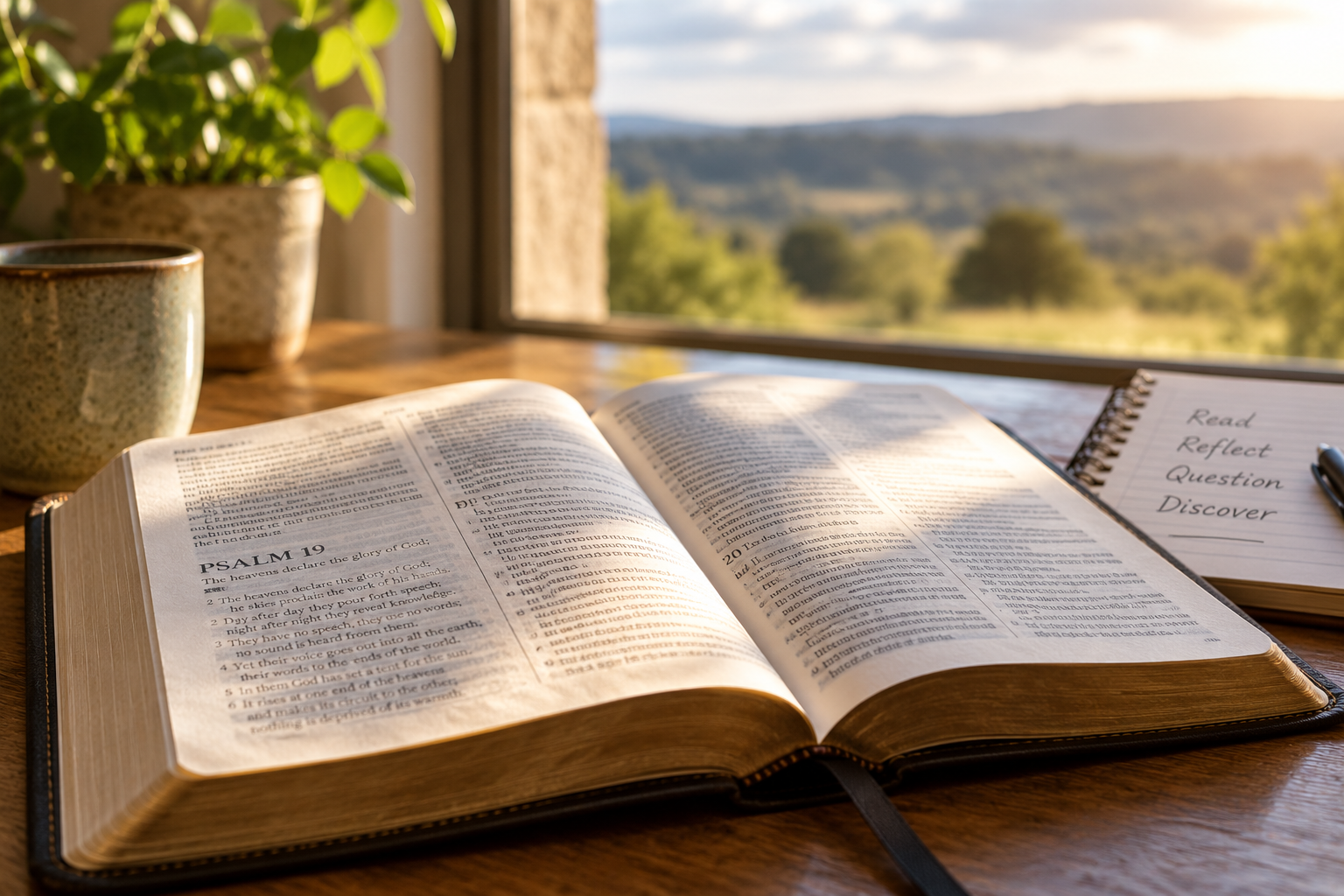
There was a time when I thought that taking the Bible seriously meant that I had to take everything in it literally.
Perhaps that isn’t surprising. When we first begin exploring Christian faith, we often look for certainty. We want to know what Christianity teaches, what we are supposed to believe, and where we can find reliable answers. And for Christians, the Bible seems the obvious place to look.
But the more I read the Bible, the more I began to realise that the question was not quite as simple as I had imagined.
The Bible itself seemed to resist being read in only one way.
There were stories and histories, poems and prayers, letters and visions. There were parables told by Jesus and songs written by people experiencing joy, anger, despair and hope. There were ancient laws, prophetic warnings, wisdom sayings and accounts of communities trying to understand what God was doing among them.
And gradually another question began to emerge.
Perhaps the issue isn’t simply whether we take the Bible literally.
Perhaps the more important question is:
How do we take the Bible seriously?
What kind of book is the Bible?
One of the first things we discover when we begin looking closely at the Bible is that it isn’t really a single book.
It is a library.
Within its pages are writings produced in different periods, in different circumstances and for different purposes. Some tell stories. Some preserve laws. Some offer wisdom. Some are poetry. Some are letters written to particular Christian communities facing particular problems.
That matters because we don’t read every kind of writing in the same way.
When the Psalmist says that the trees of the field clap their hands, we don’t imagine branches literally applauding. The poetry is doing something much richer than giving us botanical information.
When Jesus tells the story of the Good Samaritan, the significance of the story doesn’t depend upon us proving that a particular traveller once left Jerusalem for Jericho and was attacked by particular robbers.
The question is not, Did this happen exactly as described?
The question Jesus leaves with his listener is much more demanding:
Which of these people became a neighbour?
And then:
Go and do likewise.
Recognising the kind of writing we are reading doesn’t make Scripture less important.
It helps us hear what Scripture is actually saying.
Literal isn’t always the same as faithful
Sometimes Christians worry that once we stop insisting upon a literal interpretation of every biblical passage, anything becomes possible.
If this isn’t literal, what else can we question?
It is an understandable concern.
But there is another danger.
We can become so concerned with defending whether something happened literally that we fail to ask what the biblical writer is trying to tell us.
Genesis is an obvious example.
Christians can spend enormous amounts of energy debating precisely how and when the world was created. But the opening chapters of Genesis are asking some extraordinarily profound questions.
Why is there something rather than nothing?
What is the relationship between God and creation?
What does it mean to say that creation is good?
What does it mean to be human?
What responsibilities accompany our place within creation?
What has gone wrong with the relationship between human beings, God, one another and the earth?
Those questions haven’t become less important because modern science can tell us things about the development of the universe that the ancient writers could never have known.
If anything, they have become more important.
Science can help us investigate how the universe developed.
Scripture invites us to wrestle with questions of meaning, relationship and responsibility.
They aren’t necessarily rival conversations.
Context matters
There is another reason we need to do more than simply read the words on the page.
The Bible was not originally written to twenty-first-century Christians in Britain.
Its writers and first readers inhabited cultures very different from ours. They lived with assumptions about family, society, power, gender, slavery, warfare, illness, government and the natural world that may be unfamiliar to us.
That doesn’t mean their words have nothing to say to us.
It means understanding them requires some work.
When we read one of Paul’s letters, for example, we are effectively reading somebody else’s correspondence. We hear Paul’s side of a conversation with a Christian community in Corinth, Rome, Galatia or elsewhere, often without possessing the letter or message that prompted his response.
So we ask questions.
What was happening?
Who was being addressed?
What problem was the writer responding to?
What would these words have meant to their first hearers?
And only then do we ask:
What might they mean for us?
That isn’t avoiding the authority of Scripture.
It is taking Scripture seriously enough to listen before assuming that we already know what it says.
But doesn’t interpretation make everything subjective?
Perhaps this is where things become uncomfortable.
If interpretation is involved, how do we stop ourselves simply making the Bible say whatever we want it to say?
It is an important question because interpretation can certainly be misused.
But there is no completely interpretation-free way of reading the Bible.
The moment we read an ancient text in a modern language, make decisions about which passages apply directly to us, compare one biblical passage with another, or try to understand what a writer meant, we are interpreting.
The choice isn’t really between:
interpreting the Bible
and
simply believing the Bible.
We all interpret.
The more useful question is whether we do so thoughtfully, prayerfully and honestly.
That means allowing Scripture to challenge us rather than merely looking for verses that confirm what we already think.
It means listening to other Christians.
It means learning something about history and biblical scholarship.
It means recognising that Christians before us have sometimes been deeply confident about interpretations that later generations came to question.
And perhaps it also requires humility.
We may occasionally have to say:
I might be wrong.
That isn’t the opposite of faith.
It may be one of the disciplines faith requires.
Reading the Bible through Jesus
For Christians, there is another important part of the conversation.
At the centre of Christian faith is not a book.
It is Jesus.
That doesn’t diminish the Bible. Quite the opposite: the Bible is the principal way through which we encounter the story of Jesus and the faith from which he emerged.
But it does affect how Christians read Scripture.
Jesus himself interpreted Scripture. He debated its meaning. He challenged interpretations that placed religious observance above compassion. Again and again he drew people back towards love of God and love of neighbour.
So when I encounter a biblical interpretation that seems to produce cruelty rather than compassion, exclusion rather than restoration, or self-righteousness rather than love, I think it is reasonable to return to Jesus and ask whether something has gone wrong in the way we are reading.
Not because Jesus gives us an easy rule for resolving every difficult passage.
He doesn’t.
But because Christians believe that in Jesus we see something decisive about the character and purposes of God.
He therefore becomes more than another subject within the Bible.
He becomes the one through whom Christians learn to read it.
A Bible big enough for questions
Perhaps one of the great gifts of the Bible is that it doesn’t hide the questions.
Job argues.
The Psalmists complain.
Ecclesiastes wonders what any of it means.
Prophets challenge accepted religious practice.
The disciples misunderstand Jesus.
Early Christians disagree about what faithfulness requires.
Even within Scripture, faith is not presented as a world in which everyone possesses simple answers.
It is a continuing conversation about God, humanity, suffering, hope, justice, love, failure and redemption.
That makes the Bible, for me, not less trustworthy but more compelling.
It contains people wrestling with God rather than merely talking about God.
And it gives us permission to wrestle too.
Taking Scripture seriously
So can we take the Bible seriously without taking everything literally?
I believe we can.
Indeed, sometimes taking the Bible seriously may require us not to read a passage literally.
Taking Scripture seriously means asking what kind of writing we are reading.
It means paying attention to context.
It means listening for what the writer was trying to communicate.
It means being willing to learn from scholarship and from other Christians.
It means recognising our own assumptions.
And it means returning again and again to Jesus.
None of that gives us an easy Bible.
Perhaps we shouldn’t expect one.
The Bible has accompanied communities of faith for centuries precisely because each generation finds itself returning to these ancient words with new circumstances and new questions.
And perhaps the aim isn’t simply to reach the point where we can say:
I know what the Bible says.
Perhaps the deeper question is:
What is God inviting us to see through these words—and what difference might that make to the way we live?
That seems to me a much more interesting reason to keep reading.
Leave a Reply