
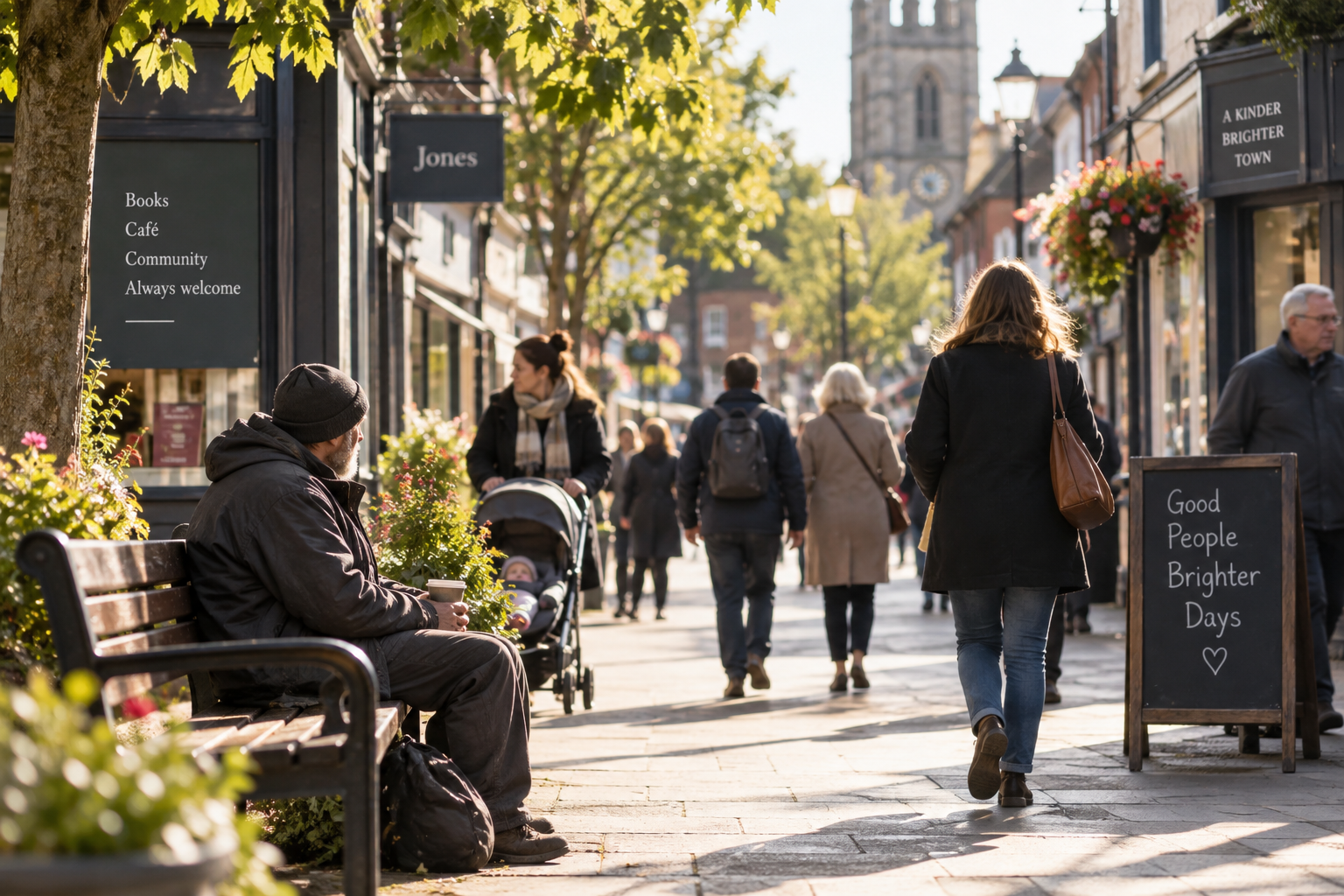
Most of the Christian life is lived on a Monday.
Not in church. Not during a hymn or a prayer. Not while listening to a sermon or receiving Communion.
It is lived while making breakfast, travelling to work, answering an email, talking to a neighbour, deciding what to buy, caring for someone, becoming irritated with somebody, watching the news, walking through a park or wondering how we are going to get through everything that needs doing that day.
Sunday matters. Gathering for worship matters. Prayer, Scripture and Christian community can nourish us, challenge us and help us see our lives differently.
But if following Jesus means anything, surely its influence cannot end when we leave the church building.
Perhaps one of the most important questions of discipleship is therefore also one of the simplest:
What difference does following Jesus make to the way I live an ordinary day?
Learning to notice
One of the things that strikes me when I read the Gospels is how often Jesus notices people.
He notices people others pass by.
He notices Zacchaeus in the tree. He notices Bartimaeus calling from the roadside. He notices the woman who touches his cloak in the crowd. He notices children when others apparently consider them an interruption.
Again and again, Jesus seems to see people whom others have stopped seeing.
I was reminded of this when I first came to Sutton Coldfield. The town is generally regarded as an affluent area, and people knew that I had previously ministered in a much more deprived community. One day, while talking about homelessness, a woman said to me, “But there is no poverty in Sutton Coldfield.”
I began to describe some of the people I had encountered on the main shopping street: people sitting in doorways, others spending their days on benches, drinking from cans or asking passers-by for money. One man had told me that he had been sleeping rough in the town for thirty years.
She was astonished.
The problem wasn’t that she lacked compassion. She simply hadn’t noticed them.
And I suspect she wasn’t unusual.
Perhaps people can become part of the scenery we pass every day. Like an old poster on a noticeboard, they have been there for so long that eventually we stop seeing them.
But something began to change.
People started noticing. Conversations followed. Attitudes began to shift. And eventually members of the congregation called for us to establish a food bank, which has now been serving the community for thirteen years.
It began, in a sense, with seeing what had always been there.
Perhaps that is one of the places where everyday discipleship begins.
With noticing.
Who do I pass without really seeing?
Who serves me in a shop or café without my giving them much thought?
Who lives nearby but rarely has anyone stop to talk?
Who seems quieter than usual?
Who might need someone simply to listen?
We cannot respond to every need we encounter, and trying to do so would quickly become overwhelming. But perhaps following Jesus gradually teaches us to move through the world with our eyes a little more open.
Sometimes discipleship may begin simply by noticing the person in front of us.
The choices nobody sees
Some of the decisions that shape our lives seem very ordinary.
What we buy.
What we eat.
How we spend our money.
How much we consume.
How we treat the things we own.
What we throw away.
Where our money is invested.
None of these necessarily feels particularly spiritual.
And yet our everyday choices connect us with people and places we may never see. The food on our plate, the clothes we wear, the energy we use and the things we buy all have stories behind them.
There are people involved.
There are animals involved.
There is creation involved.
Perhaps discipleship includes becoming more curious about those connections.
Not because there is always one perfectly Christian choice. Life is usually more complicated than that.
But following Jesus might lead us to ask different questions.
Do my choices reflect compassion?
Who or what bears the cost of the way I live?
Do I really need this?
Could I use what I have differently?
These may not be questions we traditionally associate with discipleship.
Perhaps they should be.
Relationships as places of discipleship
It is relatively easy to speak about love in the abstract.
It becomes rather more demanding when love has a name and a face.
Jesus’ command to love our neighbour sounds wonderfully inspiring until our neighbour irritates us.
Forgiveness sounds beautiful until there is actually something to forgive.
Patience sounds admirable until someone tries it.
This is where faith becomes very ordinary indeed.
It appears in the way we speak to someone when we are tired.
In whether we listen or merely wait for our turn to speak.
In how quickly we judge someone whose life we don’t understand.
In whether we need to win every disagreement.
In whether we are willing to apologise.
In whether we can forgive.
And perhaps in whether we can disagree with someone while continuing to treat them with dignity and love.
None of these things is dramatic.
Most will never be noticed by anyone else.
But perhaps this is precisely where discipleship is formed.
Not primarily in the great declarations of faith we make, but in the thousands of small encounters through which we learn what love actually requires.
What do we do with what we have?
Jesus spoke surprisingly often about money and possessions.
Perhaps that is because what we do with what we have reveals something about what we value.
For most of us, decisions about money are also very practical. There are bills to pay, responsibilities to meet and futures to think about. Christian discipleship does not remove those realities.
But it may change the questions we ask about them.
How much is enough?
What does generosity look like for me?
What am I accumulating, and why?
How much of my security depends upon possessing more?
Could something I have become a blessing to somebody else?
These questions are not invitations to guilt.
They are invitations to freedom.
Jesus repeatedly warned about the danger of allowing possessions to possess us.
Perhaps generosity is one way of loosening their grip.
Finding God in ordinary things
There is another danger in separating Sunday faith from weekday life.
We can begin to imagine that God is particularly present in certain places and moments.
Church.
Prayer.
Holy Communion.
A retreat.
A beautiful act of worship.
And God may indeed meet us profoundly in those places.
But what if God is also waiting to be noticed elsewhere?
In a conversation.
In a meal shared with someone.
In the first signs of spring.
In laughter.
In silence.
In an unexpected kindness.
In the person who needs our attention.
In the opportunity to forgive.
In the beauty of the world around us.
Perhaps part of discipleship is learning to recognise the sacred woven through the ordinary.
Not because everything that happens is good or because every experience has been sent by God.
But because there may be no part of our lives in which God’s presence and invitation cannot be encountered.
When the Kingdom becomes visible
Jesus spoke repeatedly about the Kingdom of God.
He did not describe it simply as somewhere we go after we die. He spoke about something drawing near. Something beginning. Something that could already be glimpsed.
A different way of living.
A world in which the hungry are fed, the excluded are welcomed, the broken are restored, enemies can become neighbours and those whom society overlooks are seen.
Christians have prayed for centuries:
“Your kingdom come, your will be done, on earth as it is in heaven.”
Perhaps everyday discipleship is one of the ways that prayer begins to take flesh.
Whenever compassion replaces indifference.
Whenever forgiveness interrupts resentment.
Whenever generosity challenges greed.
Whenever someone who has been excluded is welcomed.
Whenever creation is treated with care rather than simply as something to consume.
Whenever another human being is truly seen.
None of these actions creates the Kingdom of God by itself.
But perhaps they allow us to glimpse what God’s Kingdom looks like.
Monday morning
Most of us will never do anything that the world considers extraordinary.
Our lives are largely made up of ordinary days.
Meals.
Conversations.
Work.
Shopping.
Friendships.
Responsibilities.
Mistakes.
Decisions.
Moments of kindness and moments when we wish we had behaved differently.
And perhaps that is not a problem for Christian discipleship.
Perhaps ordinary life is exactly where discipleship belongs.
Following Jesus does not necessarily mean adding more religious activity to an already crowded week.
It may mean learning to live the life we already have differently.
To notice more.
To listen more carefully.
To consume more thoughtfully.
To forgive more readily.
To hold what we possess a little more lightly.
To recognise God in places we might previously have overlooked.
And then, when Monday morning comes around again, perhaps the question is not simply:
What do I have to do today?
But also:
How might following Jesus become visible in the way I do it?
Leave a Reply